

Blubird
UX/UI
2026


The story behind
This project started with a real experience. María José, one of our team members, was vacationing in Hawaii with her family when they received a tsunami emergency alert. The sirens were going off. The notification said: "EVACUATE COASTAL AREAS." But she had no directions, no shelter location, or route. She had no idea what to do next.
That moment became our brief.


Blubird was developed at SF iTrek, an international hackathon in collaboration with Cornell Tech and UDEM, where I was selected to represent Shenkar College in a multidisciplinary team of engineers and designers, tasked with solving real-world challenges.

70% of tourists are unaware of local Tsunami risks,
let alone know where shelter is...

HMW:
How might we provide people with
actionable, hyper-local directives
when existing emergency
notifications leave them uncertain of
their next move?
The Solution:

In Native American traditions, the blue bird is a sacred guardian spirit that guides people toward safety, protection, and good fortune.

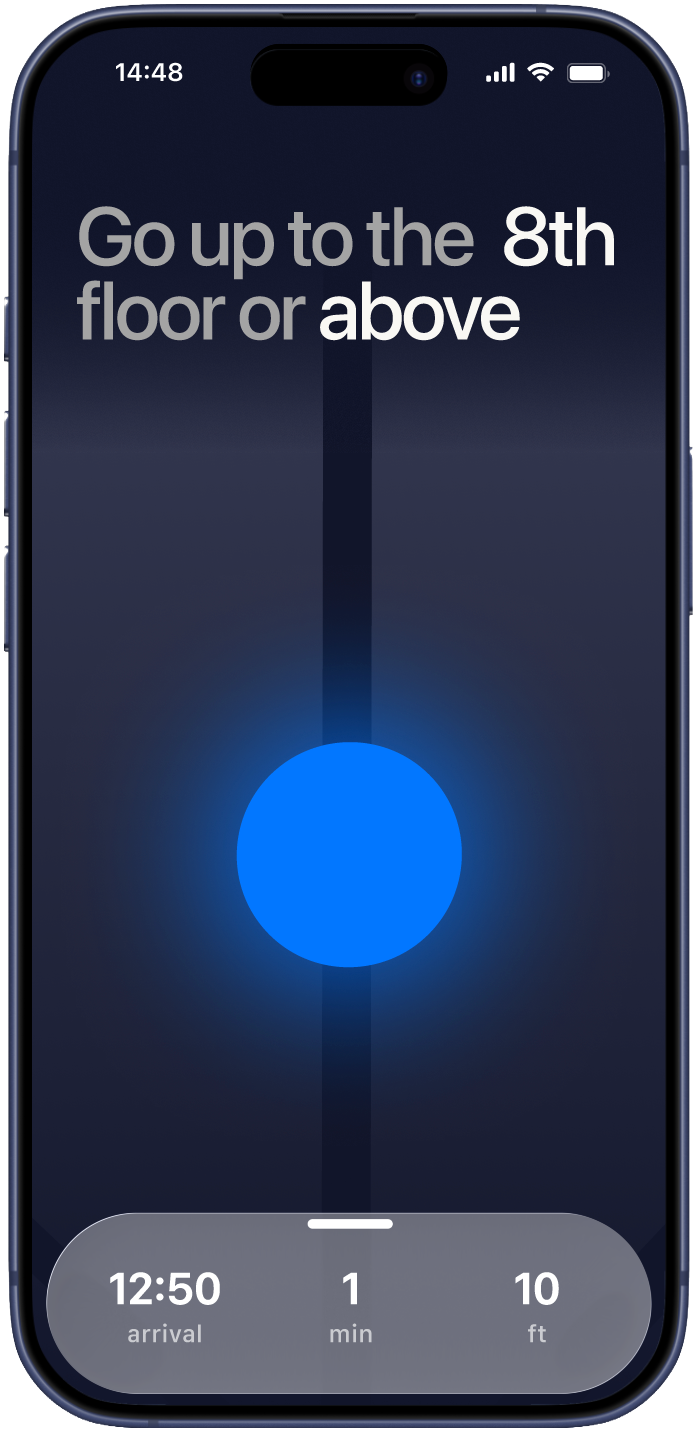
The moment an emergency alert pops up, Blubird intercepts it and adds a single button to the lock screen: Navigate to Safety. No app to find. No setup under pressure. One tap, and you're moving.
No room for confusion. In an emergency, every extra element on screen is a decision you have to make. Blubird makes none optional - one big arrow. The screen doesn't ask you to think - it tells you exactly where to go, and nothing else.

The Process

Defining the problem in a workshop in the Institute of Design at Stanford
Before the hackathon, each of us independently researched the disaster tech space. In my own research, one idea kept coming up: a navigation system that works like Apple's "Find My" - guides you to safety and shelter, and prevents overcrowding. When the team met, María José told us what happened to her in Hawaii. That was it. The research clicked into place around a real story, and the direction was clear.
References
Since Blubird is designed to be embedded directly in the OS, we looked at Apple's own design patterns as the foundation - interfaces that already work under pressure, without requiring the user to learn anything new.


Apple's ״Find My" - Precision Finding - We kept that same stripped-down logic but adapted it - higher contrast, and we added a street outline beneath the arrow so users can orient themselves within their immediate surroundings.
Apple Maps - Turn-by-Turn -
What worked: the next instruction dominates, everything else is secondary.
What didn't: designed for drivers with time to read. Our context required fewer elements and a simplified map.


"Find My" - Full-screen color, no animation. We used this layout for Blubird's arrival state, But we added a message button to notify your emergency contacts that you're safe.

Blubird was presented at the SF iTrek finale to a panel of industry judges and an audience of dozens of professionals and students from Cornell Tech, UDEM, and Shenkar College - alongside practitioners from the field who came to see the work.

Blubird is an OS-level feature designed to bridge the gap between receiving an emergency alert and knowing what to do next. It was developed during an international hackathon with Cornell Tech and UDEM in San Francisco, where I represented Shenkar College in a multidisciplinary team of designers and engineers, tasked with solving a real-world problem in natural disaster response.
Most emergency systems tell you there's a danger. They don't tell you where to go. Blubird connects directly into the phone's OS and integrates geolocation data, flood maps, and real-time crowd reports to guide users through a precise evacuation route - step by step, in any language, even when cell service is down.